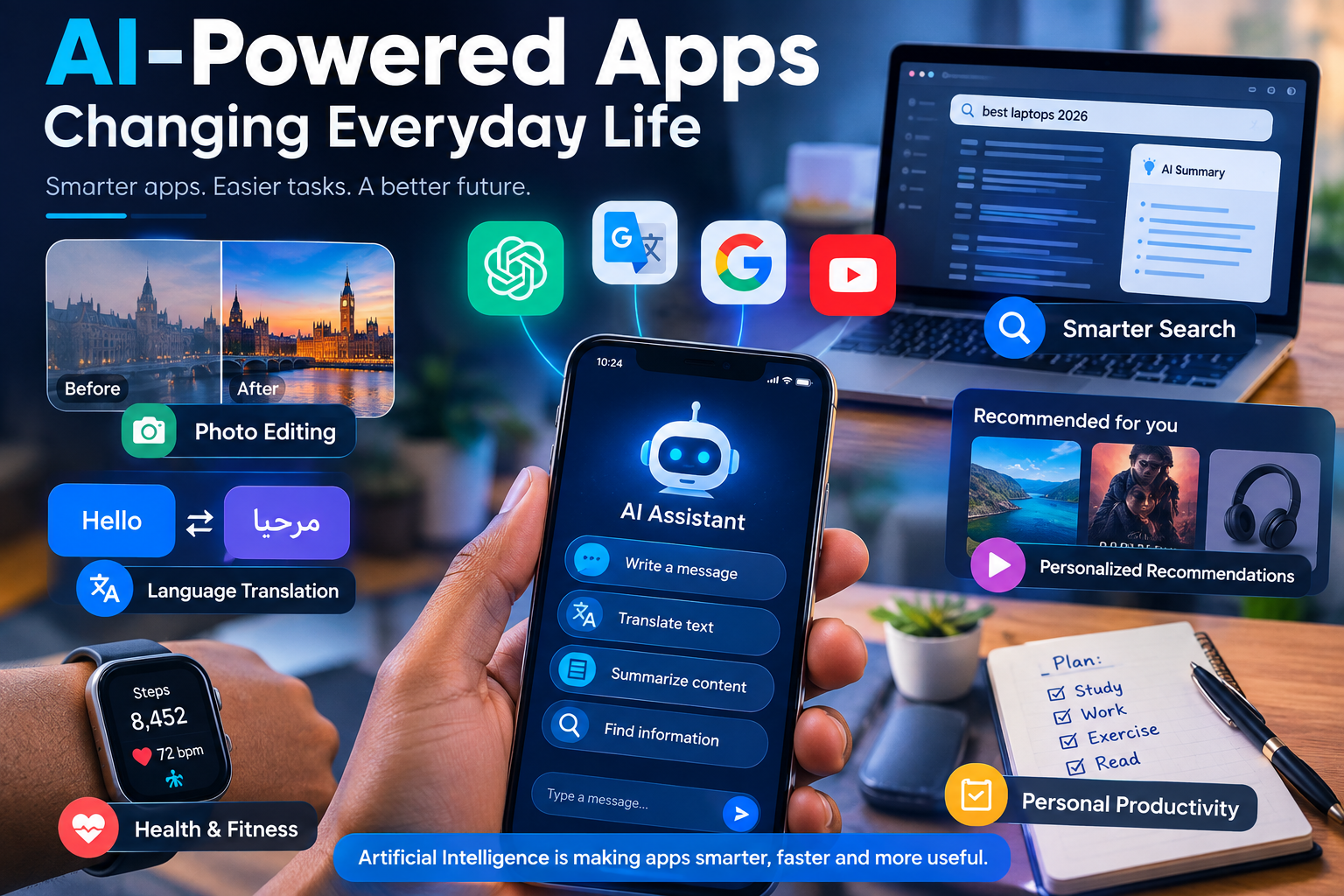
Artificial intelligence is no longer limited to research laboratories or large technology companies. Today, Artificial Intelligence is becoming part of everyday life through mobile apps, websites, smart devices, and online services. Many people use AI-powered applications without even realizing how much technology is working behind the scenes.
From improving photos to recommending videos, translating languages, organizing information, and helping people write messages, AI-powered apps are making many daily tasks faster and easier.
What Are AI-Powered Apps?
AI-powered apps are applications that use Artificial Intelligence to analyze information, recognize patterns, understand language, or make useful predictions.
Unlike traditional applications that usually follow a fixed set of instructions, AI-powered apps can process large amounts of information and provide results based on what they learn from data.
For example, a photo application may use AI to recognize a face and automatically improve the image. A music application can study your listening habits and recommend songs that you may enjoy.
How Artificial Intelligence Helps With Communication
Communication is one of the areas where Artificial Intelligence has become particularly useful.
Many messaging and email services now use AI to suggest words, correct spelling, translate languages, or help users write messages. This can save time, especially when people need to communicate in another language.
AI-powered translation tools can also make communication between people who speak different languages easier. Although translations may not always be perfect, modern AI systems can understand context better than many older translation methods.
AI Is Changing How People Search for Information
People traditionally used search engines by typing keywords and looking through several websites. Artificial Intelligence is changing this process by helping users find and understand information more quickly.
AI-powered search features can understand natural-language questions and provide more relevant results. Some applications can also summarize long documents or explain complicated topics in simpler language.
This can be especially helpful for students, professionals, and anyone who needs to understand a large amount of information in a short period.
Artificial Intelligence in Photography and Video
Smartphones have made photography accessible to almost everyone, and Artificial Intelligence is making mobile cameras even more powerful.
Many camera and editing apps use AI to recognize objects, faces, lighting conditions, and backgrounds. These features can automatically improve brightness, remove unwanted objects, enhance details, and organize photos.
Video applications also use AI for features such as automatic captions, background removal, noise reduction, and editing suggestions. These tools allow beginners to create better content without needing advanced editing skills.
AI-Powered Recommendations
Have you ever noticed that an app recommends a video, song, product, or article that seems interesting to you?
Artificial Intelligence often plays an important role in these recommendations.
AI systems can analyze information such as previous searches, viewing history, purchases, or interactions. The system then identifies patterns and uses them to suggest content that may match a user’s interests.
This technology is widely used by entertainment platforms, online stores, social media services, and news applications.
Artificial Intelligence and Personal Productivity
AI-powered apps can also help people organize their daily activities.
Some applications can create reminders, summarize meetings, organize notes, generate ideas, and help users manage tasks. AI writing tools can help with drafting emails, creating outlines, checking grammar, or improving the clarity of text.
For businesses and freelancers, these features can reduce the amount of time spent on repetitive tasks.
However, users should still review AI-generated information before relying on it, especially when accuracy is important.
AI in Health and Fitness Apps
Artificial Intelligence is also being used in health and fitness applications.
Some apps can analyze exercise patterns, track activity, provide workout suggestions, and identify trends in personal data. Smartwatches and other wearable devices can collect information such as activity levels and sleep patterns, while AI can help interpret that information.
These applications can be useful for general wellness, but they should not replace professional medical advice.
Are AI-Powered Apps Always Accurate?
Artificial Intelligence can be powerful, but it is not perfect.
AI systems can sometimes misunderstand questions, produce incorrect information, or make poor recommendations. The quality of the result depends partly on the data and technology behind the application.
For this reason, users should treat AI as a helpful tool rather than assuming that every answer is automatically correct.
Privacy is another important consideration. Before using an AI-powered app, users should understand what information the application collects and how that information is used.
The Future of AI-Powered Apps
The use of Artificial Intelligence in everyday applications is likely to continue growing. Future apps may become better at understanding individual preferences, recognizing natural language, automating routine tasks, and helping users make decisions.
AI could make smartphones and other devices more personalized and useful. Instead of simply following commands, applications may increasingly understand what users are trying to accomplish and provide assistance automatically.
Final Thoughts
Artificial Intelligence is changing everyday life by making many applications smarter and more helpful. From communication and photography to search, entertainment, productivity, and fitness, AI is already part of many common digital experiences.
How AI-Powered Apps Are Changing Everyday Life